Would you determine a man’s origins and character by the piece of cloth he hangs around his neck? Would you judge him by the way he polishes his boots?
Not until you engage him in conversation will you start to understand who he really is. Otherwise, you risk judging a book by its cover.
In this post, I veer away from the typical how-to of fishing to share a glimpse of my life story, growing up amidst the Bangweulu Swamps. My experiences reflect hardships similar to those of many Unga and Bisa children raised in a poor rural setting.
Ng’ungwa lies at the eastern edge of the Bangweulu Swamps and is renowned for its populations of black lechwes, sitatungas, and the famous shoebill stork. It serves as a boundary between the Bu-Bisa mainland of Chief Chiunda Ponde and the Ba-Unga swamps of Chief Bwalya Mponda. The area is home to Chikuni, a Ramsar Site recognised as a Wetland of International Importance and an Important Bird Area by BirdLife International.
According to Bisa folklore, the place is named after Ng’ungwa, a huge tuskless elephant discovered by the first settlers. Many also refer to the area as Muwele, named after the most famous village headman, who was among the first to settle there. To this day, the most important institutions in the region bear his name.
While in sixth grade at Muwele Primary School, my nephew, Eddie Mwanda, from Chafye Island in the heart of the Bangweulu wetlands within the chiefdom of Bwalya Mponda, joined me as a first grader. Chafye did not have a school at that time (1979). Following the death of my mother in early 1974, I was placed under the care of my uncle, Bayama (my mother’s brother). That event led to my sudden change of custody, and I had not been to the swamps since that year.
In April, as schools closed, I asked Bayama if Eddie and I could go on holiday to Chafye, about 70 km away. I longed to see my sister (Eddie’s mother), and with my nephew present, I felt deeply nostalgic and wanted to rekindle our long-lost family bonds.
“Do you think you can manage to travel to Chafye at your age?” Bayama asked, noting that I was 13 and Eddie was just 8.
“Yes, Bayama. We can,” I replied, and Eddie nodded in agreement.
“It’s farther than you think—more than nine hours of serious paddling,” he warned.
“We’re good at paddling; we’ll manage it in a day,” I insisted.
“No, you can’t. If you’re really that eager, get a lift from adults,” Bayama stated.
Seeing the gloom on our faces and recognising our determination, he reluctantly agreed and allowed us to leave the following Monday.
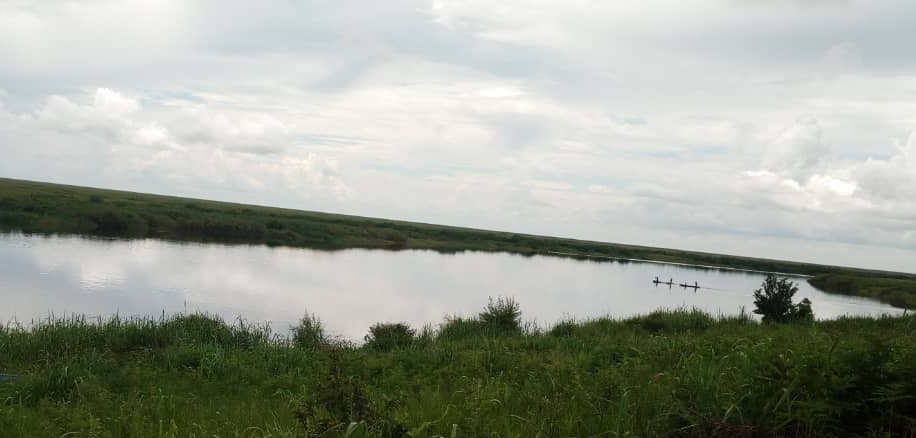 |
| Lukulu River before floods |
We set off on a bright sunny day; no
wind on that warm, exciting Monday morning. The sky was clear, and the water was still surging all over, saturating the banks of the Lukulu River. Lukulu was heavily
pregnant. It appeared menacingly evil for two young, inexperienced paddlers. The
rising water was coffee-brown from ash from dry-season-burnt grass, which
was later washed into the river. Even the grassy floodplains between Chafye and Muwele were overwhelmed, with water omnipresent.
Armed with only our two paddling poles
and a small, short spear, we started off in a short, heavy, semi-
finished Mupundu canoe (Mukondo). We travelled light. We only had a bag, a few bananas, and some mealie meal in a plastic bag.
Off we went down strong currents of
Lukulu, which was, at the time, said to have had several pods of hippos and basks
of crocodiles lurking all over the overflowing river. The fierce current of
Chikuba, a man-made canal adjacent to Lukulu, also helped us propel the canoe
faster in the initial stages of our journey.
Eddie was born lame with no fingers
on his left hand. He was such an intelligent boy and radio fanatic that he
could recite the entire popular Cibemba radio drama, Ifyabukaya, at the
age of four. He was thus nicknamed Mwansa Kapeya after the veteran broadcaster who was the program’s producer and presenter at the time. (Former Member
of Parliament for Mpika Central). The name still lives on as Eddie’s mother is popularly
known as Mother of Mwansa Kapeya.
Because of his physical handicap, I
did not expect him to help me much in paddling. Alas! He proved me wrong!
“You can rest now, I’ll paddle,” I
said.
“Not until I get tired. After all, if
I sit, we won’t reach Chafye in time. This canoe is too heavy,” he answered,
with astounding determination.
“But it’s better you rest now, so you
can help when I’m tired.”
“No, Bayama, we’d better move
faster now when there’s light than when it’s dark.”
The stump did not make him any worse
at paddling. Not until he got tired after a long distance. That was despite his
tender age! We followed the river as it meandered down, sticking to the route
Bayama defined for us. After we had passed a small island and a fishing camp called Kaleya, Lukulu angled left. Still, we took an almost indistinct creek that arched right, leading us into the inundated, caterpillar-ridden floodplains. As expected, there was no clear channel to follow, so we relied on the not-so-clear chart of landmarks drawn by Bayama.
We sang Catholic hymns as we went, boosting each other’s morale, passing landmark after landmark. Both Muwele and Chafye were growing remote as
we entered the dense green vegetation. We would flush some birds
and animals as we progressed, which were just as scared of us as we were of
them. We even crossed a track of elephants that had just passed, marked by fresh, steaming dung.
Once, we saw a murmuration of vultures near a termite mound, which suggested there might be an animal carcass nearby, but we couldn’t dare go anywhere near. We feared the raider might
be there, which was why the vultures were just hovering about. With such thoughts,
we dabbled faster. At times, we found adorable flocks and throngs of birds, such as white storks, geese, and ducks, in shallow waters or in meadows.
At around 14:00 hours, we saw a nearby fishing camp. We decided to go
and have lunch there. We found two fishermen who generously cooked and
gave us game meat for our Nshima. We didn’t have a fancy for meat so much as we would have loved a red-breasted tilapia, because Bayama was unofficially a meat supplier. He was an accomplished poacher, and his home was nicknamed “Safari.”
We had meat almost daily, occasionally replaced by catfish. However, we
were grateful for the men’s generosity.
We had to eat as quickly as we could, as we were at a place called Mulimbule, almost halfway to our destination.
Though we could see the tallest Eucalyptus trees from Chafye over clear plains,
the distance was still significant. With renewed energy, we set off.
We were advised against following the
direction of the alluring trees and cutting across because some areas, though visible from afar, had dense sedges that wouldn’t allow a canoe to pass through.
We were shown a beaten waterway to follow until we reached the channel to
Chafye. We paddled uneventfully until we were slowed by tall bulrush sedges that preceded a sitatunga covert made of papyrus and phragmites reeds.
“It’s all grass here, Bayama, we can’t
pass,” Eddie told me as I tried to propel the canoe forward.
“Where did we lose the way? It seems
we’ve followed directions given by the men at the camp,” I said as we started
to reverse the canoe.
“This thicket must be the overgrown
Lumbatwa river they talked about,” Eddie said, recalling what one man had said.
“Yes, then what do we do? It seems
there’s no shortcut here. We had to find the one and only waterway, “I said as
we pondered whether to go up or down along the blocked river.
“Let’s go down,” he said.
The sun seemed to be on a cruise to
set. My arms had started to ache. Birds chirped merrily, and a soft wind blew across the bulrush sedges, making them swing rhythmically back and forth. We could see several bird nests of different
sizes hanging on reed plumes. There was no time to watch these fascinating woven
works of art by birds. We had to move on, or else get lost in the night.
About thirty meters away, we found a
wide waterway (Lucheta). We broke into ecstasy as we followed the creek
between thick beds of bulrush sedges (kabele). We had crossed the Lumbatwa River. This is a long, deep river from the Senior Chief Kopa chiefdom that flows into the swamps of Bwalya Mponda.
The creek was short, leading us into an open swamp that made the beaten waterway invisible once more. We had to follow the direction of trees from
Chafye, which were getting closer and closer, as the reliable and evident guide.
We were in high spirits and so thrilled to be celebrating our maiden long-distance trip on our own. It was a feat we would boast about. We would
prove to Bayama that we were grown up enough. We would win respect with
this expedition! Our constantly downtrodden egos are boosted. We were full of
confidence that my sister would celebrate us, which, to us, was more
important than how wayward Bayama alleged we were for insisting on
this voyage.
But we had to really earn that because our
biggest test was yet to come.
We saw the sun slowly and silently peer over the horizon as we paddled from meadow to meadow, over colourful, spreading, and blossoming tropical water lilies. The deep green appearance of fresh grass covered the water like a huge blanket, giving an outstanding elevation to the not-so-tall trees of Chafye Island. Schools of fish swam freely as they foraged on emerald-green grass, leaving some floating and others lying like woven mats over the water. Flocks of birds had begun returning to their habitats as the familiar
humming of nighthawks called in the evening.
By then, Eddie was tired, and I was
paddling alone. As we got closer, the grass grew taller again, and the water,
though shallower, became marshy. Movement became slower. There was no clear Lucheta again!
In search of the way, I turned left, following deeper waters toward fewer sedges. No way in sight! Swarms of mosquitoes had begun feasting on us. Their stung tingling like pricks of sharp needles. The
deeper I went, the more difficult it became to find the way. I was exhausted. Both my feet and chest felt
heavy.
We decided to turn back and search
from the other direction, up north. The situation was the same. It was now
evening. We were becoming very
desperate. We could faintly hear people’s voices and other noises from Chafye.
The clamour of drums was inviting. But we couldn’t find Lucheta.
“Get into the blanket, Eddie,” I
said. “There are just too many mosquitoes here.”
“It’s time to help you, Bayama.
How can I see while covered in a blanket?”
“It’s okay, I’ll navigate the way,” I said, overcome by guilt for disobeying Bayama.
“We’re into this together,” he said,
picking up his paddling pole.
As we went further up, we grew increasingly demoralised. Our excitement vanished. It was getting darker and darker.
The night caught up with us. There was no moonlight. We were in the thick of trouble.
We decided to try to cut across the thick
grassy patch that dauntingly stood in our way. As we pushed forward, the canoe
could not move an inch. We disembarked, pushed and pulled harder until we found
a relatively clear pool. It stretched from Left to right with little grass here
and there. The water was very deep. As we moved farther, we saw grass tottering ahead, followed by intermittent pow, pow, pow sounds. We could see waves in all directions, but there was neither a current nor a wind.
Then, as we got closer to the
vegetation, the noise of fish splashing and gasping for fresh air at the
surface grew louder! It was a huge school of catfish! The number of fish was so great that some even dared to hit our paddles. As we continued, we came to a solid, marshy, and overgrown floating island.
“This is the end, Bayama,”
Eddie announced, stunned, as our canoe came to a full stop on compact mud.
“It’s a floating meadow. It’s Chitali.”
“How do you know?” I asked, getting despondent
too. My hope of getting to Chafye that day almost shattered.
“Because we come to fish here with dad.
It’s quite a distance from the village.”
“Can they hear us if we shout for
help?”
“Only those in transit. Not people in
the village.”
“From which direction do you normally
come?”
“From the east. But this floating
meadow is long,” Eddie said in despair.
“Okay, then we go back a little,
follow the pool and head east,” I said, encouraged by my illusory joy of seeing
my sister that evening.
“L-e-t’s try,” Eddie said reluctantly.
He was on the verge of breaking down.
We reversed and turned right. Just after
about ten meters, we stormed into the middle of Lucheta, which was as wide
as a cycle path.
 |
| Lucheta leading to the village - Picture by A. Kafuko. |
“Finally!” we shouted in unison!
We went into jubilation! Our hopes were regained.
We enthusiastically sang “Twakulumbanya
We Mfumu”, Eddie’s favourite praise song. We were sure we would reach our
coveted destination in no time!
Twenty minutes later, we arrived in Chafye to
a mixture of emotions. People were surprised that we had made it from that
distant place all by ourselves. Tears of joy rolled down my sister’s cheeks as
we reunited, five long years after the death of my mother. Our joy was
indescribable.
We told my brother-in-law about the
catfish while recounting our day’s ordeal. Men went early the following morning
to spear the fish, and the catch was amazing; hundreds per person.
With the confidence and experience gained from navigating the swamps, we later frequently spent our holidays with my sister, though not for long. When I
went to Secondary School, Eddie transferred to Bwalya Mponda and,
unfortunately, died a year later. His death devastated me. It was hard to
believe his charisma had gone.
Nevertheless, from that day in April
1979, my numerous voyages between Ng’ungwa and the islands of Matongo, Kasoma Lunga, and Bwalya Mponda began. Like philosopher Epictetus
correctly observed, “Lameness is a hindrance to your leg, not to your ability
to choose, unless that is your choice.” I learnt this, fortunately, from Eddie’s determination and refusal to seek sympathy whatsoever. So, even when we are in neckties with polished shoes today, we recognise the struggles of those poor children in Bangweulu Wetlands facing very difficult choices, because whatever our station, we are all Tubulus with similar childhood experiences.
 SoundCloud



Comments